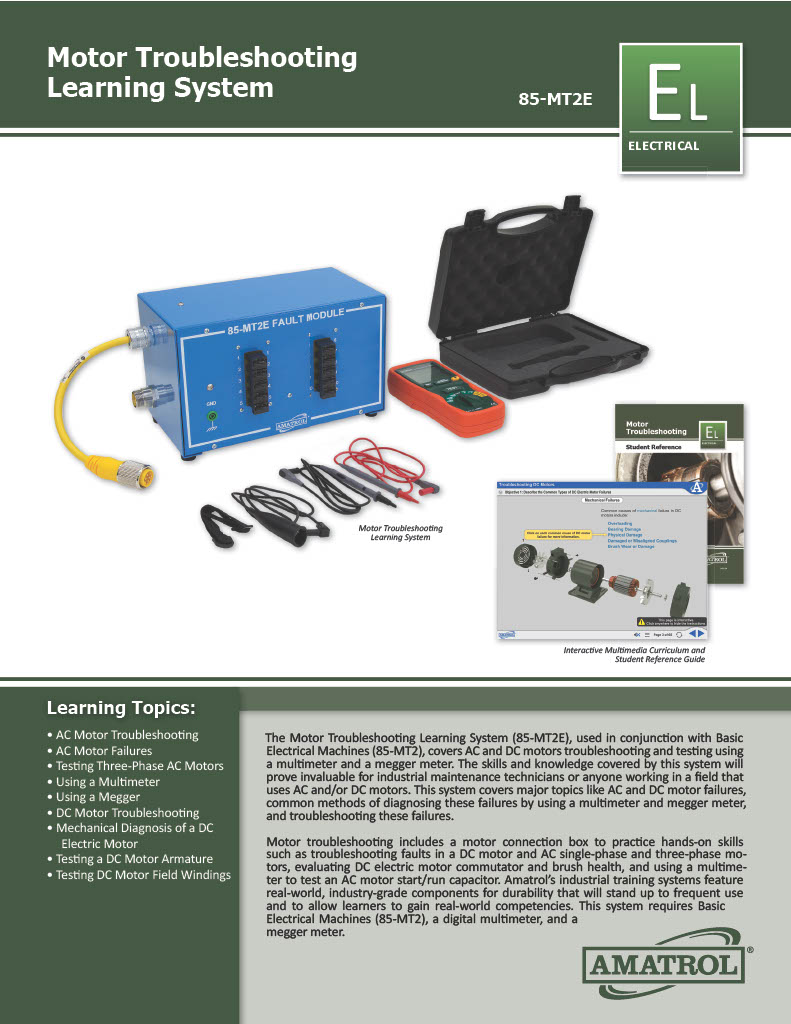


DAC Worldwide’s Centrifugal Clutch Cutaway (200-2204) depicts a modified industrial centrifugal clutch for mechanical drive training in a classroom or laboratory. This sectioned mechanical power transmission component uses centrifugal force to connect two concentric shafts by throwing a centrifugal shoe outwards at a right angle to the primary shaft axis, which allows for shift during start-up.
Amatrol’s Wound Rotor Motor Learning System (85-MT2D) covers the function, operation, and performance characteristics of wound rotor motors. While variable frequency drives (VFDs) and standard induction motors have replaced wound rotor motors in many applications, these motors are still used for heavy-duty, high torque applications such as industrial cranes and hoists. Amatrol’s wound rotor motor training system requires the Basic Electrical Machines Learning System (85-MT2) for use.
Wound rotor motor training includes a wound rotor speed controller, a wound rotor motor, banana leads, in-depth multimedia curriculum, an installation guide, and a student reference guide. These components will be used to study topics such as wound rotor speed control, performance characteristics, and motor reversing. Amatrol systems feature real-world, industrial-grade components for both durability and to facilitate learners in gaining hands-on practice with actual equipment that they’ll find in the field.
Amatrol’s Electric Motor Troubleshooting Learning System (85-MT2E), used in conjunction with the required Basic Electrical Machines Learning System (85-MT2), covers AC and DC motors troubleshooting and testing using a multimeter and a megger meter. The skills and knowledge covered by this system will prove invaluable for industrial maintenance technicians or anyone working in a field that uses AC and/or DC motors. This system covers major topics like AC and DC motor failures, common methods of diagnosing these failures by using a multimeter and megger meter, and troubleshooting these failures.
The 85-MT2E includes a motor connection box to practice hands-on skills, such as troubleshooting faults in a DC motor and AC single-phase and three-phase motors, evaluating DC electric motor commutator and brush health, and using a multimeter to test an AC motor start/run capacitor. Amatrol’s industrial training systems feature real-world, industry-grade components for durability that will stand up to frequent use and to allow learners to gain real-world competencies.
The AC Elector Motor Control Systems Trainer will give your students hands-on learning with motors found in industrial, commercial, and residential applications. It's versatile, comprehensive, and has eLearning built around it. Watch for a quick overview of the system.
Amatrol’s Electric Motor Control Learning System (85-MT5) teaches electric relay control of AC electric motors found in industrial, commercial, and residential applications. Learners study industry-relevant skills including how to operate, install, design, and troubleshoot AC electric motor control circuits for various applications.
The 85-MT5 includes a bench top-mount control workstation, motor workstation, AC induction motor, control component panels, multimeter, lead set, and student curriculum that is unmatched within the industry. This system uses industrial-quality components to train learners to become better prepared for what they will encounter on the job. Some of the major components that learners will work with include a control transformer, reversing contactors, manual motor starter, multi-function timer, and control relays.
The 85-MT5 teaches learners how to troubleshoot motor control circuits under realistic conditions. Circuit faults can be introduced using either the included manual fault insertion system or through the optional Fault Troubleshooting System (890-FTS1), which includes Amatrol’s FaultPro, the industry’s only electronic-fault insertion software.
Amatrol’s Motor Braking Learning System (85-MT5A) adds to the Electric Motor Control Learning System (85-MT5) to expand a learner’s knowledge of the common electric motor braking methods found in industrial, commercial, and residential applications. Braking is essential to motor control when motors must be stopped and restarted multiple times. Common applications include rolling mills, conveyors, and power fans. Learners study industry-relevant skills for three of the most common braking methods: electromagnetic braking, plugging, and DC injection braking. Troubleshooting braking problems under realistic conditions allows learners to experience the challenge and reward that result from applied problem solving.
The motor braking training system includes a DC braking station with power supply, transformer and bridge rectifier mounted to a slide-in panel, inertial load module with flywheel, electromagnetic brake, plugging/anti-plugging switch, student curriculum, and instructor’s guide. This system uses industrial quality components that stand up to frequent use and enable learners to better prepare for what they will encounter on the job.
Amatrol’s Reduced Voltage Starting Learning System (85-MT5B) adds to the Electric Motor Control Learning System (85-MT5) to teach methods of starting electric motors under reduced voltage, 3-phase power distribution using Delta and Wye transformer wiring configurations, and troubleshooting. Reduced voltage starting is ideal for applications where full motor torque could tear or damage a product, such as paper or delicate fabric. Learners will study Wye-Delta power distribution, types of voltage circuits, and the operation of an autotransformer reduced voltage starter.
Reduced voltage starting includes a Dual Transformer Station, featuring two control transformers, and a Power Resistor Station, featuring three 25-ohm, 100-watt resistors. This industrial motor control training system uses industrial-quality components that stand up to frequent use and enables learners to practice with real-world components that they will encounter on the job.
Amatrol’s Variable Frequency AC Drive Learning System, AB PowerFlex (85-MT5C) adds to the Electric Motor Control Learning System (85-MT5) to teach basic and advanced concepts related to variable frequency drives (VFDs), as well as their many industrial applications, including fans, pumps, conveyors, mixers, grinders, and hoists. For example, learners will study the operation, installation, design, performance analysis, and troubleshooting of VFDs.
Learners will also practice hands-on skills like programming and operating a variable frequency AC drive to ramp a motor up to its rated speed and decelerate to a stop. The training system features heavy-duty, real-world components, such as an Allen-Bradley PowerFlex4 VFD, multi-turn potentiometer for speed control, and selector switches for general drive control, basic stop/start, ramping, and dynamic braking. These industry-standard components prepare learners for situations that they will encounter on the job.
Amatrol’s Electronic Sensors Learning System (85-MT5D) adds to the Electric Motor Control Learning System (85-MT5) to teach the function and applications of a variety of electronic sensors in industries like automotive, packaging, and security. This electronic sensor training system is comprised of heavy-duty, real-world industrial components such as capacitive, inductive, and infrared sensors that are built to stand up to heavy use.
Learners can connect and operate these electronic sensors, study their design, and analyze their performance in order to build skills that can be applied to real-world job opportunities. Amatrol reinforces this skill-building practice with strong curriculum that thoroughly explains electronic sensor topics, such as factors that affect a sensor’s performance. This combination of hands-on skills and strong theoretical knowledge gives learners the ability to not only understand where to use a sensor in a circuit, but why it’s there and what its function is.
Amatrol’s Electronic Counter Learning System (85-MT5E) adds to the Electric Motor Control Learning System (85-MT5) to teach electrical event counting in electrical motor control circuits. Electronic counters are used in a wide variety of applications, including production counting, reject counting, sorting, and flow timing. The electronic counter training system features a digital 3-digit electronic counter set within a heavy-duty, 11-gauge steel slide-in panel built to stand up to frequent use.
This industrial training system also features world-class curriculum that covers counter and timer operation, designing circuits, and troubleshooting. Learners can then directly apply this theoretical knowledge to practice hands-on skills, such as designing a timed one-shot motor control circuit, a timed repeat cycle motor control circuit, and a motor control circuit using the counter to tally operations. Learners can also practice troubleshooting a timed one-shot motor control circuit and a timed repeat cycle motor control circuit.
Allen-Bradley Micro810
Amatrol’s PLC Motor Control Learning System - AB Micro810 (85-MT5AB8) teaches PLC operation, programming, and motor control, as well as timer and counter instructions. The PLC Motor Control training system adds to Amatrol’s Electric Motor Control training system (85-MT5) and covers in-depth topics like PLC program execution, PLC program editing and documentation, seal-in program logic, and time-driven sequencing. Skills presented by this learning system are valuable for industrial maintenance technicians in a variety of advanced manufacturing careers.
The major component on the PLC Motor Control training system is the Allen-Bradley Micro810 programmable logic controller featuring embedded 10V non-isolated 4 channel analog input and 1 channel analog output for speed control and communications via EtherNet/IP. This system also includes a lead set, USB communication cable, CCE software DVD, interactive multimedia curriculum, installation guide, and student reference guide. Amatrol provides real-world industrial components to stand up to frequent use and to best prepare learners by practicing on components that they’ll actually use in the workplace.
Pages
-
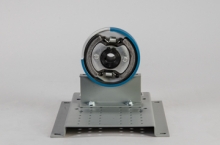 Item Number:200-2204
 -
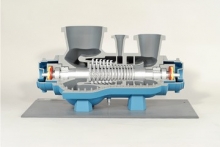 Item Number:211CThe design of the Centrifugal Compressor Model is based upon common industrial centrifugal compressors.
 -
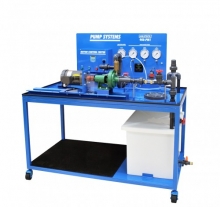 Item Number:950-PM1The model 950-PM1 Pumps Learning System teaches skills related to centrifugal pumps, which are used in almost every industry to transfer non-hydraulic fluids of various types from one place to another. Students learn a comprehensive set of industry-relevant skills including how to operate, install, maintain, troubleshoot, analyze performance, and select centrifugal pumps as well as system design.
 -
 The CFT program was created in partnership with the Material Handling Equipment Distributors Association (MHEDA) to provide skills to entry-level forklift technicians, enhancing their performance in the world of material handling. The CFT prepares individuals to repair and maintain technical systems utilizing key engineering principles that underpin most forklift vehicles.
 -
 Item Number:C-101 / C-102 / C-103 / C-104SACA’s Associate certifications are introductory Industry 4.0 certifications appropriate for operators and other individuals seeking to become familiar with Industry 4.0 factory floor automation equipment and processes.
 -
 SACA’s Certified Industry 4.0 Professional certification is an engineering certification that focuses on the analysis, design, and optimization of Industry 4.0 systems. It prepares engineers to succeed in positions in modern production environments that use Industry 4.0 technologies.
 -
 SACA’s Specialist certifications certify Industry 4.0 technical skills in operations, troubleshooting, programming, maintenance, and systems integration. Each certification is keyed to a skilled occupation.
 -
 The purpose of the Certified Logistics Technician (CLT) program is to recognize through certification individuals who demonstrate mastery of the core competencies of material handling at the front-line (entry-level through front-line supervisor) through successful completion of the certification assessments.
 -
 Item Number:CPT / CPT+ / CPT 4.0The purpose of the Certified Production Technician (CPT) ® 4.0 certification program is to recognize through certification, individuals who demonstrate mastery of the foundational, core competencies of advanced manufacturing production at the entry-level to front-line supervisor through successful completion of the certification assessments.
 -
 Item Number:CT-SCAMSSC’s Certified Technician in Supply Chain Automation (CT-SCA) logistics certification enables both students and incumbent workers to gain the skills needed to meet the definition of a supply chain automation technician established by the National Science Foundation-funded National Center for Supply Chain Automation: a technician who installs, operates, supports, upgrades or maintains the automated material handling equipment and systems which support the supply chain.