



This economical, sectioned example showcases the device’s operating principle, internal components, and related installation concerns. Multiple cutaways unveil all internal components, which enhances classroom training in HVAC system design, maintenance, troubleshooting, and preventive/predictive maintenance.
Produce Large and Complex Elastomer Parts
Create accurate elastomer parts quickly and efficiently with the ease and reliability of professional FDM 3D printing. The durable elasticity of FDM TPU 92A material makes it a good choice for a variety of applications, including flexible hoses, tubes, air ducts and vibration dampeners.
FDM® HIPS (high-impact polystyrene) is a low-cost, general-use 3D printing thermoplastic. It offers similarities to ABS but has high impact resistance making it suitable for printing lower-requirement jigs, fixtures, and prototypes at a reduced cost.
Kimya PC-FR is a polycarbonate FDM® 3D printing filament with flame-retardant properties developed specifically for additive manufacturing. It retains the beneficial characteristics of standard polycarbonate, such as dimensional stability, high glass transition temperature, and high impact resistance.
Kimya PC-FR is a polycarbonate (PC) based material with flame-retardant properties developed specifically for additive manufacturing. It retains the beneficial characteristics of standard polycarbonate such as dimensional stability, high glass transition temperature, and high impact resistance.
Key Attributes
- Flame-resistant material
- Electrical insulator
- Good dimensional stability
- Meets or exceeds the mechanical performance of Stratasys PC material
- Compatible with soluble support
- Meets EN 45545-2 and NFPA 130 standards
- Slice heights: 10
Nylon 12 is a semi-crystalline, FDM® thermoplastic. As with other semi-crystalline materials used in traditional manufacturing processes, special considerations should be implemented to ensure an optimal part is obtained. The information in this document illustrates the following considerations:
- Tip Selection
- Build Modes
- Porosity
- Sacrificial Tower Features
- Build Sheets
- Support Removal
- Annealing
FDM® Nylon 12 filament is the 3D printing equivalent of standard industrial PA12 (polyamide 12) material. A strong engineering thermoplastic that exhibits toughness and high impact strength without being brittle. Its excellent fatigue properties make it a good option for repetitive-flex applications such as snap-fit clips, closures, and press-fit inserts.
Other applications include jigs, fixtures, low-volume production parts, and accurate prototyping of nylon 12 high-volume injection molded parts. FDM Nylon 12 is available in black.
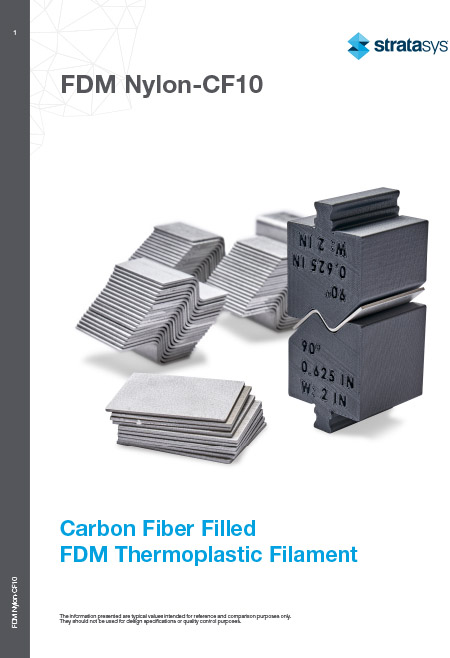
FDM® Nylon-CF10 is a composite material combining a blended nylon polymer with 10% chopped carbon fiber (by weight), enhancing the material’s strength and rigidity. The nylon base polymer also gives FDM Nylon-CF10 good chemical resistance.
FDM® Nylon 12CF™ is a PA12 (polyamide 12) thermoplastic filament reinforced with chopped carbon fiber, 35% by weight. It has the highest flexural strength of any FDM thermoplastic, resulting in the highest stiffness-to-weight ratio. The combination of high strength, stiffness, and light weight makes it an optimal replacement for heavier metal components in appropriate use cases.
Typical applications include strong, lightweight tooling, functional prototyping and select end-use parts.
FDM Nylon 6™ combines strength and toughness superior to other FDM thermoplastics, for applications that require strong, customized parts and tooling that lasts longer and withstands rigorous functional testing.
Engineered with nylon 6, a popular thermoplastic for manufacturing, this material works with the Fortus 900mc™ to produce durable parts with a clean finish and high break resistance. FDM Nylon 6 is ideal for product manufacturers and development engineers in automotive, aerospace, consumer goods, and industrial manufacturing.
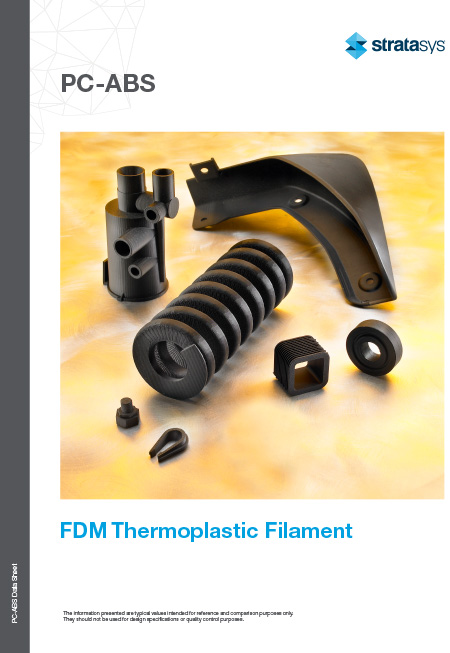
PC-ABS is a blend of polycarbonate (PC) and acrylonitrile butadiene styrene (ABS) thermoplastics. The result is an FDM filament that exhibits optimal characteristics of each – excellent strength, high toughness and heat resistance, and good flexural strength. Choose PC-ABS when you need the strength of PC but the impact resistance of ABS.
PC-ABS is suitable for various applications that include prototyping, tooling, and low-volume production. Available colors are black, white, and red.Pages
-
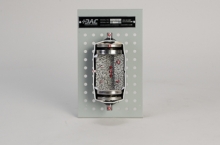 Item Number:373-602
 -
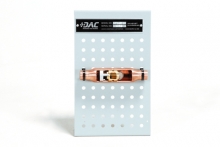 Item Number:373-510This sectioned example showcases the device’s operating principle, internal components, and related installation concerns. Color coding, flow arrows, and numbered call-outs combine to make the device more informative to the inquiring student and more useful to the instructor.
 -
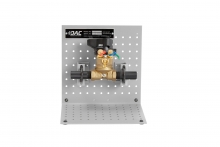 Item Number:373-551This ACR Manual Balancing Valve Cutaway provides a full cutaway view of a balancing valve that exposes the complete internal components and operating principles. The device can be used independently using an optional tabletop mounting foot, or combined with similar devices on optional display and storage frame assemblies.
 -
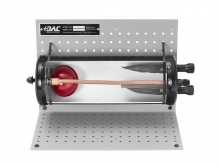 Item Number:373-721This ACR Oil Separator Cutaway, Float-Type provides a full cutaway view of an oil separator that exposes the complete internal components and operating principles. Color coding, flow arrows, and numbered call-outs combine to make the device more informative to the inquiring student and more useful to the instructor.
 -
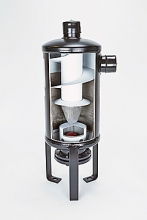 Item Number:373-722DAC Worldwide’s ACR Oil Separator Cutaway, Helical-Type is a professionally-crafted, economical teaching aid that depicts a conventional helical-type centrifugal oil separator commonly used in industrial and commercial refrigeration systems for oil entrapment and compressor crankcase replenishment.
 -
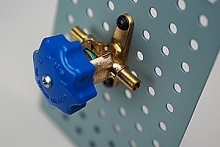 Item Number:373-503This ACR Packless Diaphragm Line Valve Cutaway provides a full cutaway view of the diaphragm line valve that exposes the complete internal components and operating principles.
 -
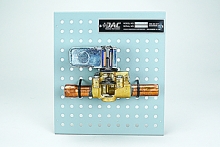 Item Number:373-502DAC Worldwide’s ACR Solenoid Valve Cutaway is a sectioned example of a commonly-encountered solenoid valve used in air conditioning and refrigeration systems with a remotely-operated maintenance-related block valve, system fluid, or gas flow control valve.
 -
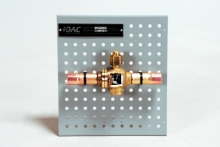 Item Number:373-501This ACR Steel Ball Valve Cutaway provides a full cutaway view of the compressor body that exposes the complete internal components and operating principles. Economically mounted on a formed-steel and powder-coated modular display panel, this sample panel can be mounted on a variety of optional benchtop display fixtures and storage structures.
 -
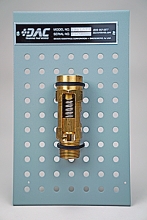 Item Number:373-506This ACR Straight-Thru Pressure Relief Valve Cutaway provides a full cutaway view of the reversing valve that exposes the complete internal components and operating principles.
 -
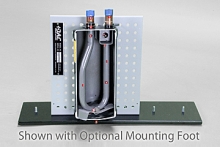 Item Number:373-701This ACR Suction Line Accumulator Cutaway provides a full cutaway view of an accumulator that exposes the complete internal components and operating principles. Color coding, flow arrows, and numbered call-outs combine to make the device more informative to the inquiring student and more useful to the instructor.