DAC Worldwide’s Centrifugal Clutch Cutaway (200-2204) depicts a modified industrial centrifugal clutch for mechanical drive training in a classroom or laboratory. This sectioned mechanical power transmission component uses centrifugal force to connect two concentric shafts by throwing a centrifugal shoe outwards at a right angle to the primary shaft axis, which allows for shift during start-up.
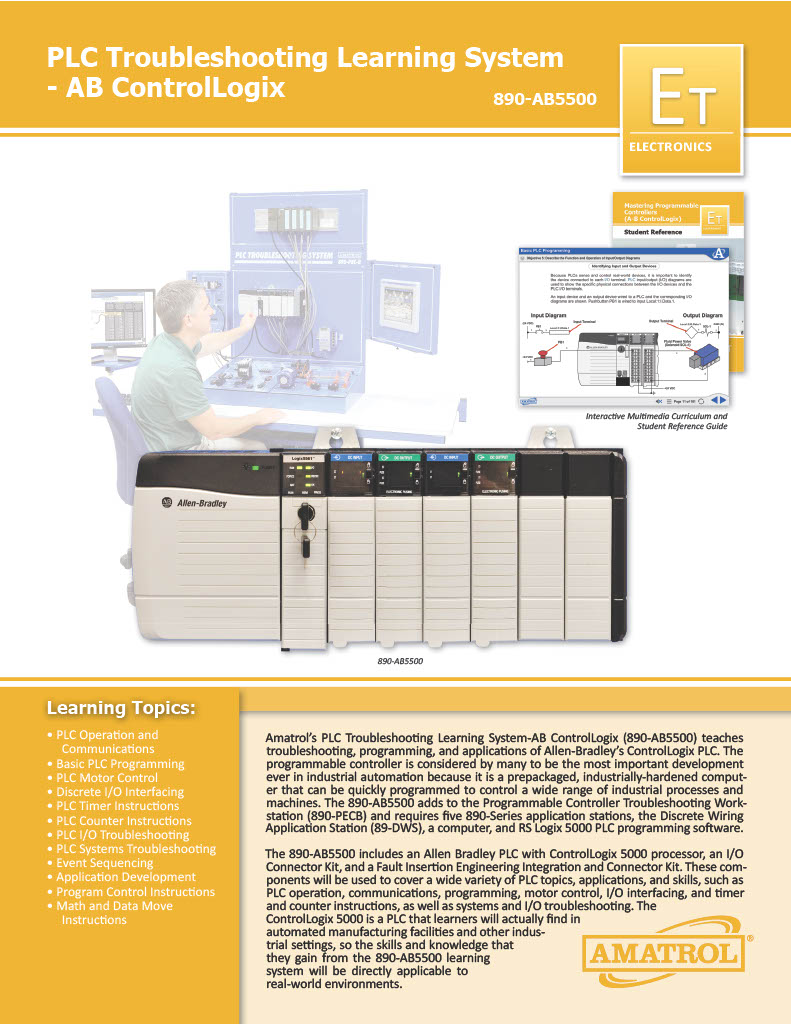
Amatrol’s PLC Troubleshooting Learning System - AB ControlLogix (890-AB5500) teaches troubleshooting, programming, and applications of Allen-Bradley’s ControlLogix PLC. The programmable controller is considered by many to be the most important development ever in industrial automation, because it is a prepackaged, industrially-hardened computer that can be quickly programmed to control a wide range of industrial processes and machines. The A-B ControlLogix training system adds to the Programmable Controller Troubleshooting Workstation (890-PECB) and also requires a computer and RS Logix 5000 PLC programming software.
The A-B ControlLogix training system includes an Allen-Bradley PLC with ControlLogix 5000 processor, an I/O Connector Kit, and a Fault Insertion Engineering Integration and Connector Kit. These components will be used to cover a wide variety of PLC topics, applications, and skills, such as PLC operation, communications, programming, motor control, I/O interfacing, timer and counter instructions, and systems and I/O troubleshooting. The ControlLogix 5000 is a PLC that learners will actually find in automated manufacturing facilities and other industrial settings, so the skills and knowledge that they gain from the A-B ControlLogix training system will be directly applicable to real-world environments.
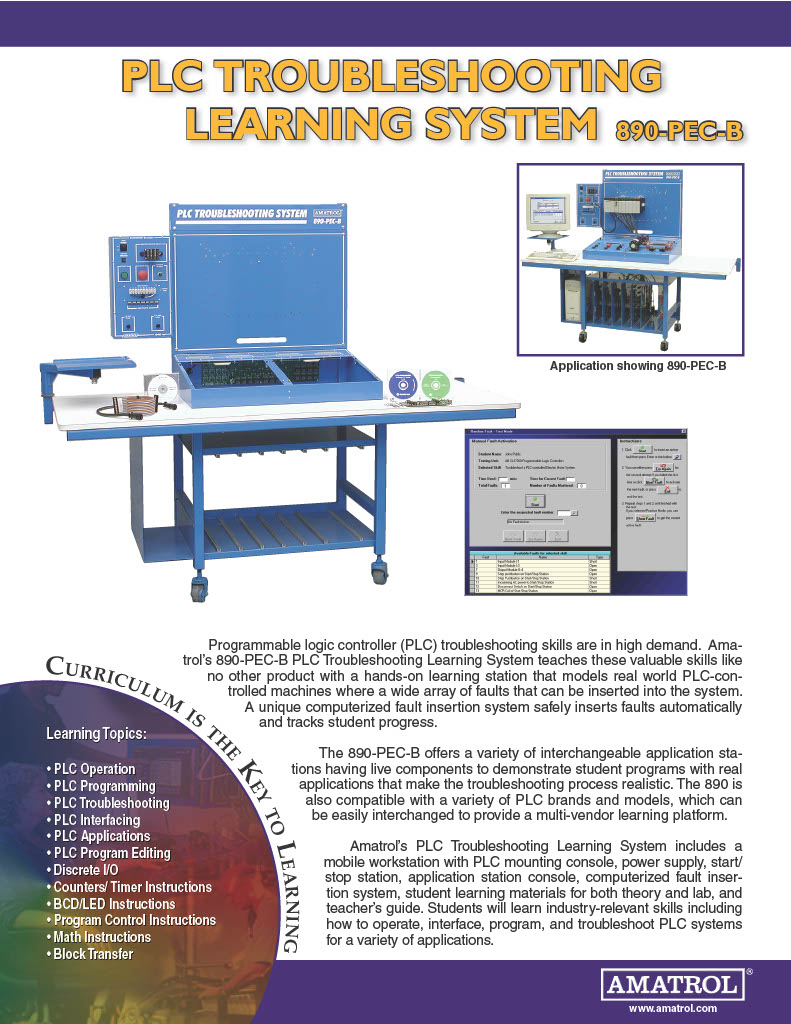
Amatrol’s Programmable Controller Troubleshooting Workstation (890-PECB) teaches programming and troubleshooting of programmable logic controllers (PLCs) and their use in industrial, commercial, and residential applications. The PLC Troubleshooting Workstation teaches PLC troubleshooting like no other product by providing a hands-on learning station that models real world PLC-controlled machines with up to 40 faults that can be inserted into the system. It’s the first product to offer a realistic PLC troubleshooting experience for students, because the faults are inserted throughout the system, including inside the PLC!
Hands-On Maintenance & Troubleshooting Skills
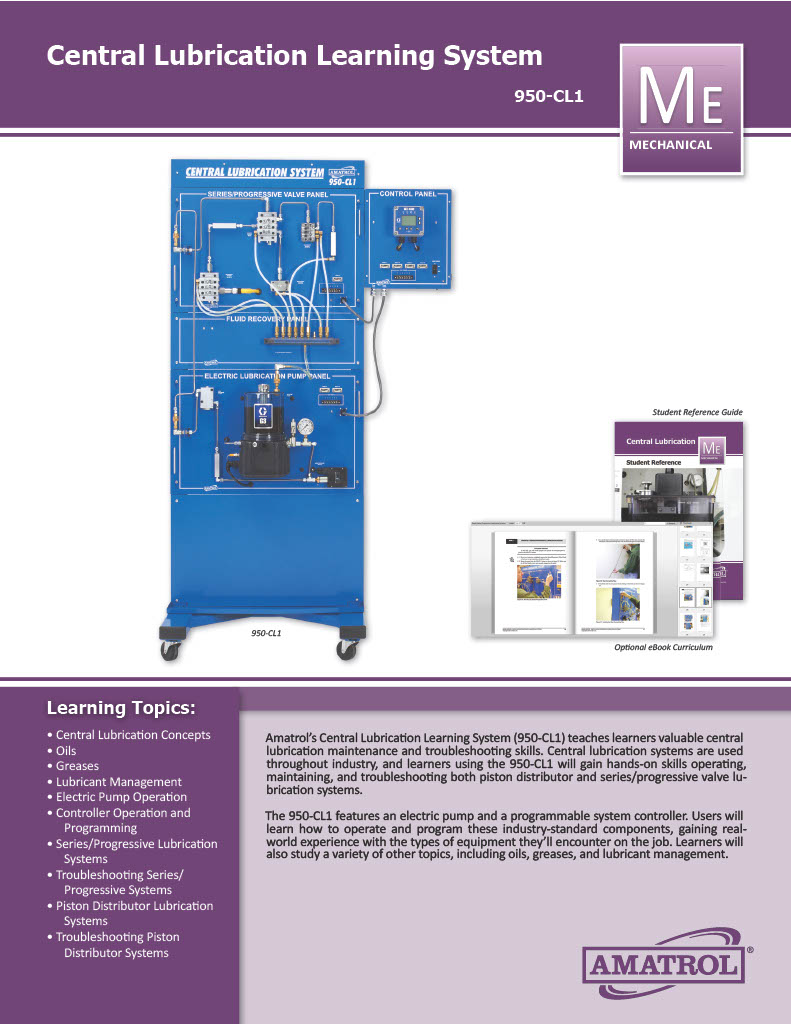
Amatrol’s Central Lubrication Learning System (950-CL1) teaches learners valuable central lubrication maintenance and troubleshooting skills. Central lubrication systems are used throughout industry, and learners using the central lubrication training system will gain hands-on skills operating, maintaining, and troubleshooting both piston distributor and series/progressive valve lubrication systems.
The central lubrication training system features an electric pump and a programmable system controller. Users will learn how to operate and program these industry-standard components, gaining real-world experience with the types of equipment they’ll encounter on the job. Learners will also study a variety of other topics, including oils, greases, and lubricant management.
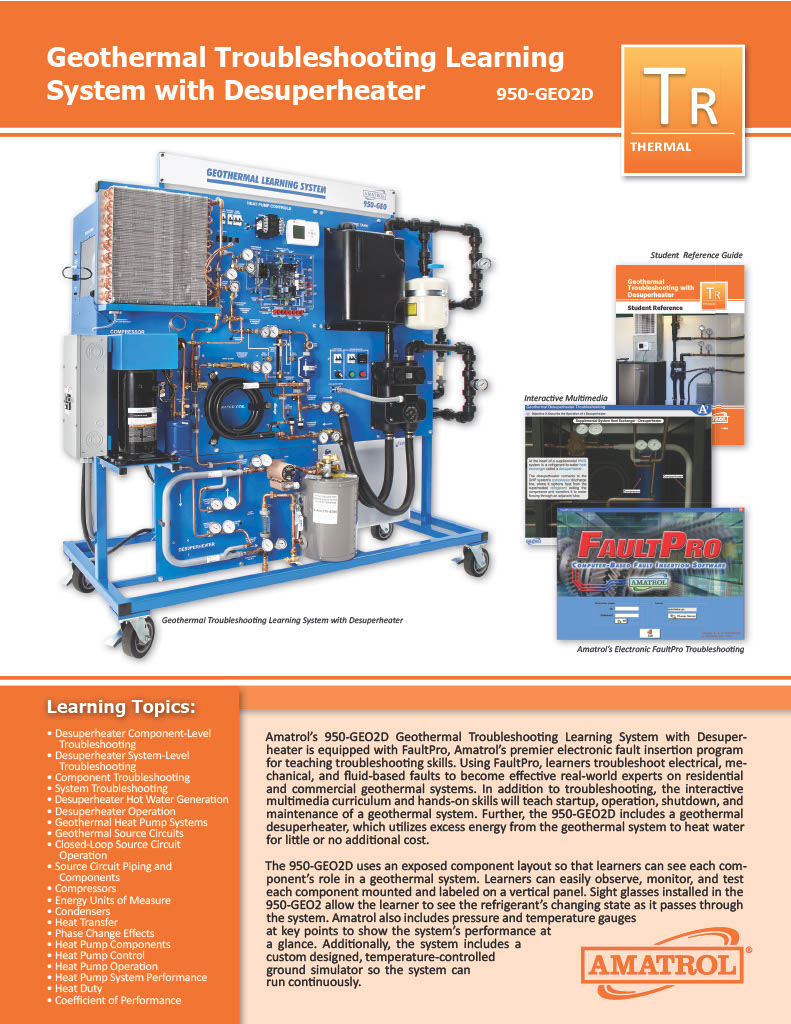
Amatrol’s 950-GEO2D Geothermal Troubleshooting Learning System with Desuperheater uses an exposed component layout so that learners can see each component’s role in a geothermal system. Learners can easily observe, monitor, and test each component mounted and labeled on a vertical panel. Sight glasses installed in the 950-GEO2 allow the learner to see the refrigerant’s changing state as it passes through the system. Amatrol also includes pressure and temperature gauges at key points to show the system’s performance at a glance. Additionally, the system includes a custom designed, temperature-controlled ground simulator so the system can run continuously.
The 950-GEO2D is equipped with FaultPro, Amatrol’s premier electronic fault insertion program for teaching troubleshooting skills. Using FaultPro, learners troubleshoot electrical, mechanical, and fluid-based faults to become effective real-world experts on residential and commercial geothermal systems. In addition to troubleshooting, the interactive multimedia curriculum and hands-on skills will teach startup, operation, shutdown, and maintenance of a geothermal system.
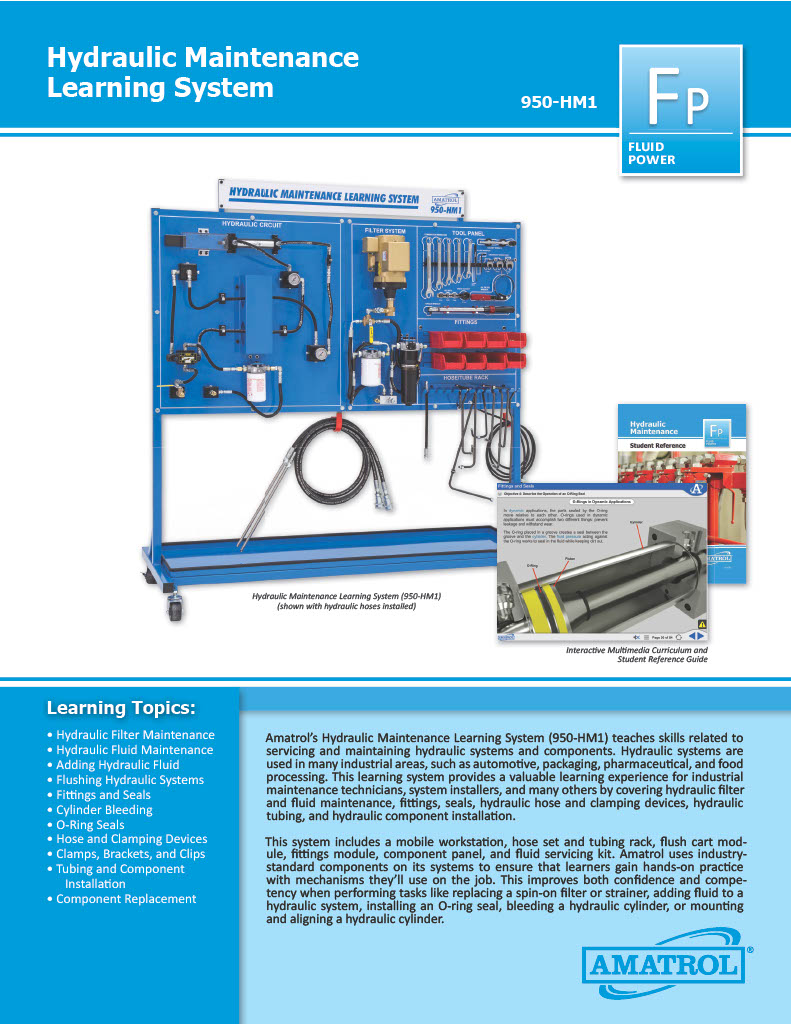
Amatrol’s Hydraulic Maintenance Learning System (950-HM1) teaches skills related to servicing and maintaining hydraulic systems and components. Hydraulic systems are used in innumerable industrial areas like automotive, packaging, pharmaceutical, and food processing. This learning system provides a valuable learning experience for industrial maintenance technicians, system installers, and many others by covering hydraulic filter and fluid maintenance, fittings, seals, hydraulic hose and clamping devices, hydraulic tubing, and hydraulic component installation.
This system includes a mobile workstation, hose set and tubing rack, flush cart module, fittings module, component panel, and fluid servicing kit. Amatrol uses industry-standard components on its systems to ensure that learners gain hands-on practice with mechanisms they’ll use on-the-job. This improves both confidence and competency when performing tasks like replacing a spin-on filter or strainer, adding fluid to a hydraulic system, installing an O-ring seal, bleeding a hydraulic cylinder, or mounting and aligning a hydraulic cylinder.
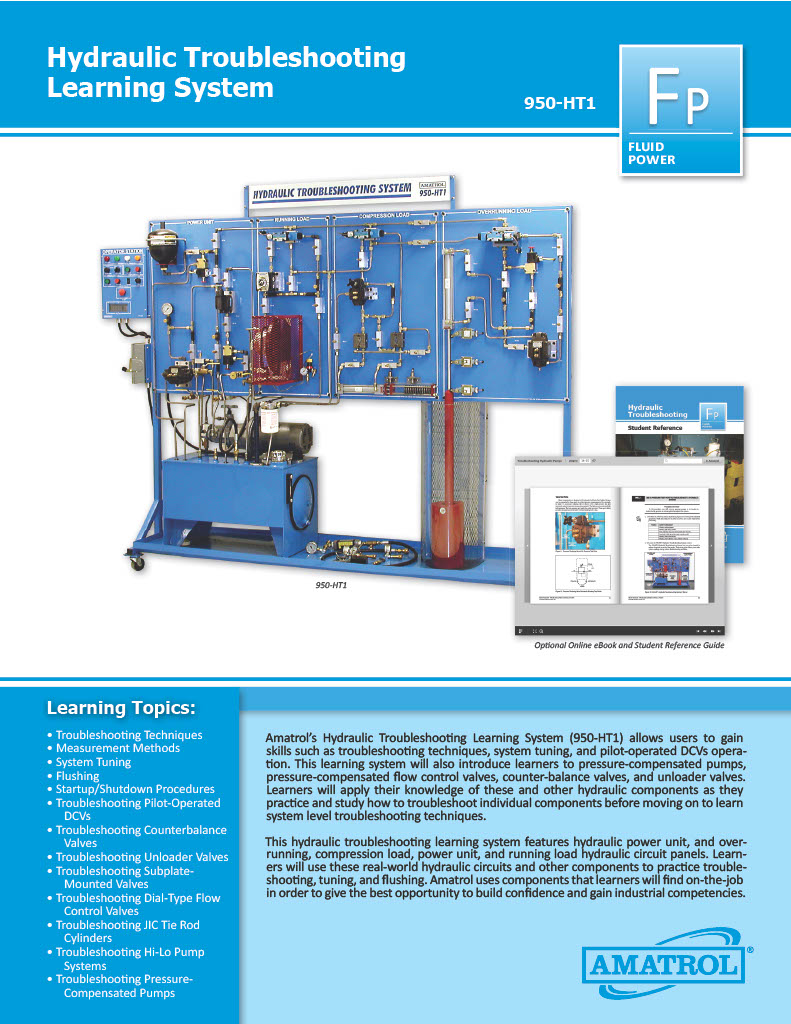
Amatrol’s Hydraulic Troubleshooting Learning System (950-HT1) teaches advanced hydraulic troubleshooting like no other product by providing a hands-on learning station that models a real world hydraulically-powered machine and includes over 40 faults that can be inserted into the system. The 950-HT1 is the first product to offer a realistic electrical component troubleshooting experience for students, because the faults are inserted throughout the system, including the hydraulic, mechanical and electrical components.
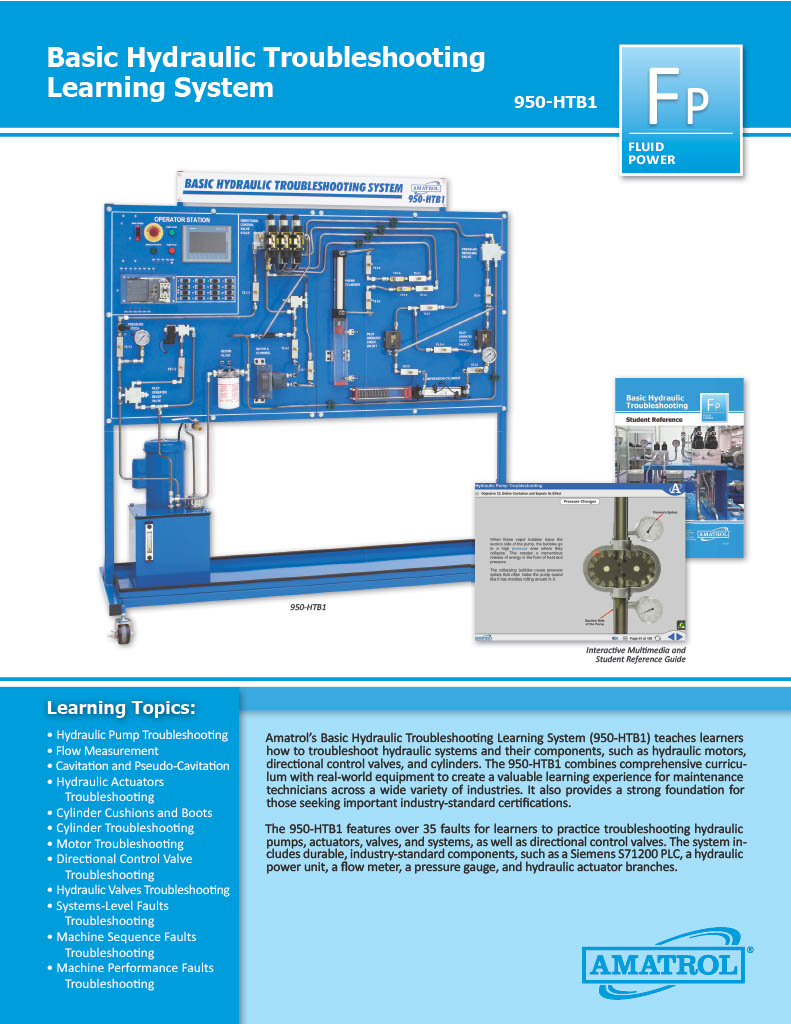
Amatrol’s Basic Hydraulic Troubleshooting Learning System (950-HTB1) teaches learners how to troubleshoot hydraulic systems and their components, such as hydraulic motors, directional control valves, and cylinders. The system combines comprehensive curriculum with real-world equipment to create a valuable learning experience for maintenance technicians across a wide variety of industries. It also provides a strong foundation for those seeking important industry-standard certifications.
The hydraulic troubleshooting system features over 35 manually-inserted faults to help learners understand and practice troubleshooting common problems found in hydraulic systems. Sample faults include: motor starter failure, defective pump, worn cylinder seals, blocked flow control valves, and blocked inlet ports.
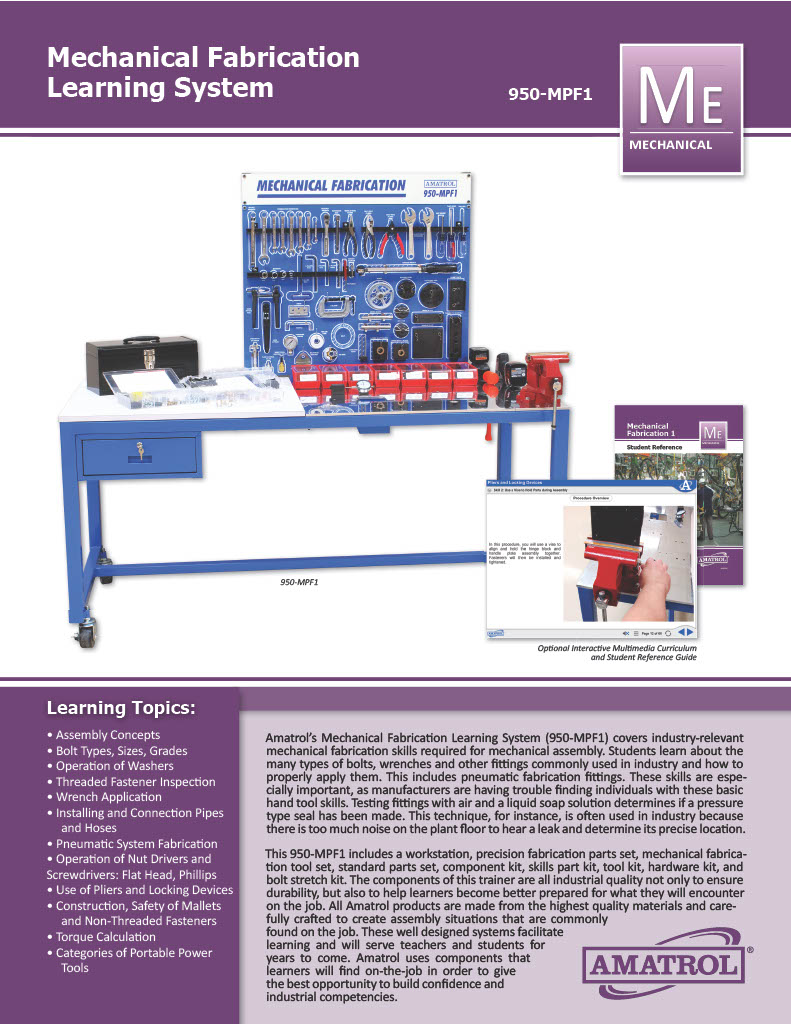
Amatrol's Mechanical Fabrication Learning System (950-MPF1) covers industry-relevant mechanical fabrication skills from basic to more sophisticated power tools, including skills ranging from using c-clamps, vises, and pliers, to more advanced torque tools, torque wrenches, and power tools. Students learn about the many types of bolts, wrenches and other fittings commonly used in industry and how to properly apply them. This includes pneumatic fabrication fittings. Testing fittings with air and a liquid soap solution determines if a pressure type seal has been made. This technique is often used in industry because there is too much noise on the plant floor to hear a leak and determine its precise location.
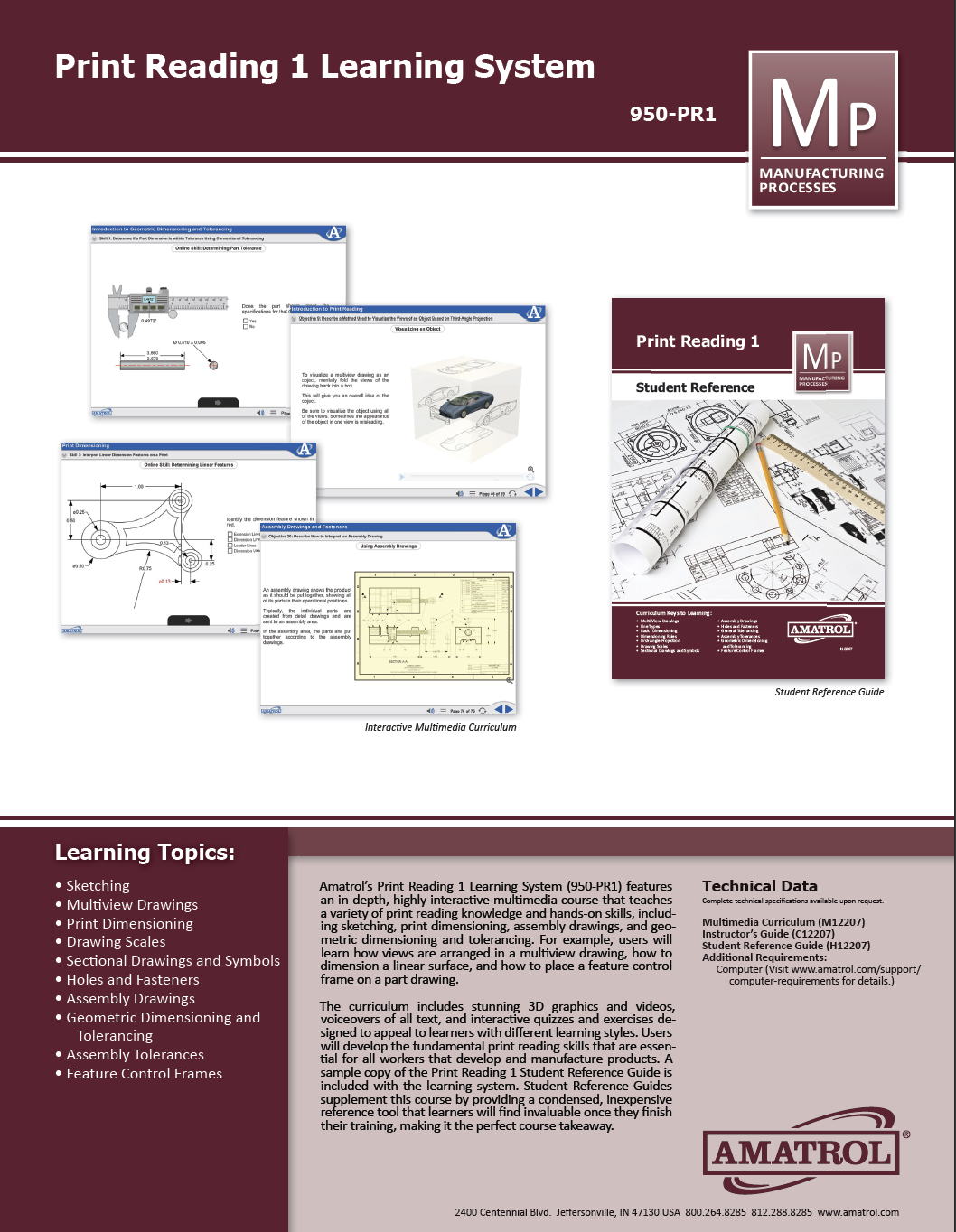
Print Reading is a foundational skill use throughout many industries. Amatrol’s Print Reading eLearning Courseware (M12207) covers topics like print dimensioning, assembly drawings and fasteners, and geometric dimensioning & tolerancing (GD&T). Learners using Amatrol’s print reading training course will study sketching, multiview drawings, dimensioning rules, first-angle projection, holes and fasteners, assembly drawings, assembly tolerances, and feature control frames. From this building block, learners can practice industry-relevant skills like selecting the appropriate number of views for an object, interpreting information blocks on a print, and calculating the limits of a dimension given its tolerance.
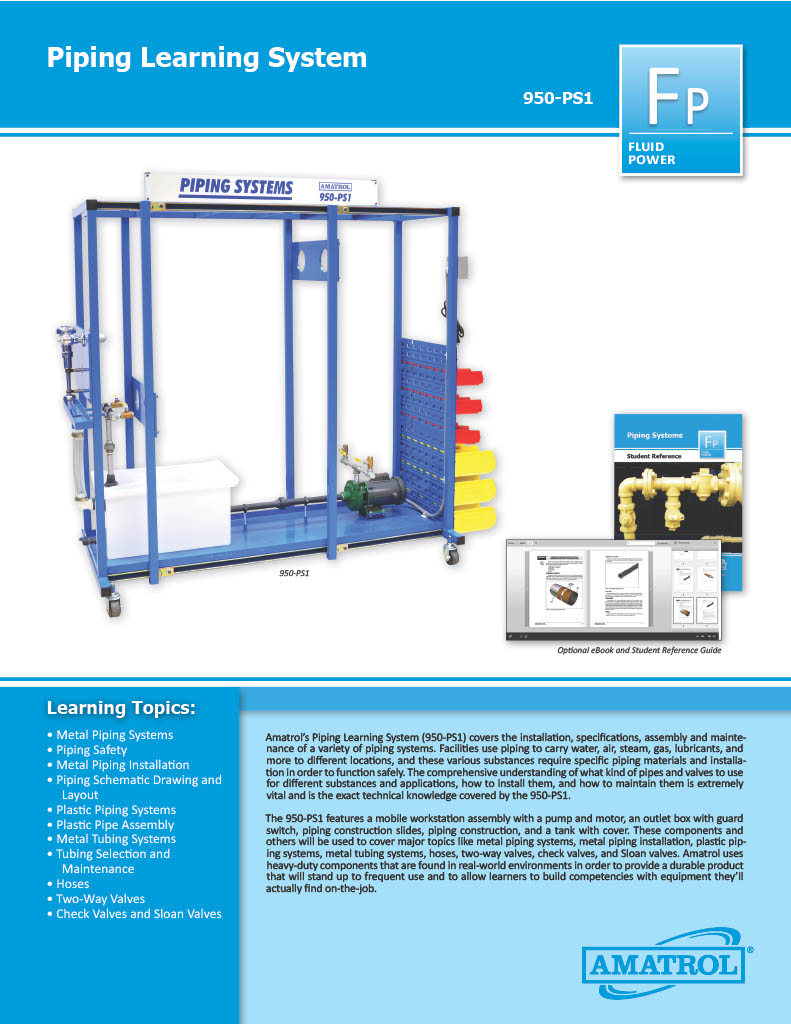
Amatrol's Piping Learning System (950-PS1) teaches learners how to lay out and assemble a fluid piping system used in industrial, construction, agricultural, and transportation applications. Students will learn how to select, size, identify, and install a variety of types of industrial fluid piping, fittings and valves including: iron pipe, steel tubing, hydraulic hose, plastic pipe, copper tubing, globe valves, gate valves, check valves, and Sloan valves.
The fluid piping trainer includes a mobile workstation, pump testing network, valve package, fitting package, fitting identification kits, Sloan valve maintenance kit, pipe insulation and hanger components, fitting storage, student learning materials for both theory and lab, and teacher’s guide. The workstation has slotted, movable members to enable a variety of hydraulic hose fluid piping application scenarios to be set up.
Pages
-
 Item Number:200-2204
 -
 Item Number:211CThe design of the Centrifugal Compressor Model is based upon common industrial centrifugal compressors.
 -
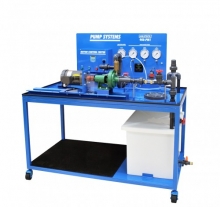 Item Number:950-PM1The model 950-PM1 Pumps Learning System teaches skills related to centrifugal pumps, which are used in almost every industry to transfer non-hydraulic fluids of various types from one place to another. Students learn a comprehensive set of industry-relevant skills including how to operate, install, maintain, troubleshoot, analyze performance, and select centrifugal pumps as well as system design.
 -
 The CFT program was created in partnership with the Material Handling Equipment Distributors Association (MHEDA) to provide skills to entry-level forklift technicians, enhancing their performance in the world of material handling. The CFT prepares individuals to repair and maintain technical systems utilizing key engineering principles that underpin most forklift vehicles.
 -
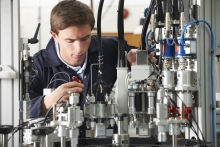 Item Number:C-101 / C-102 / C-103 / C-104SACA’s Associate certifications are introductory Industry 4.0 certifications appropriate for operators and other individuals seeking to become familiar with Industry 4.0 factory floor automation equipment and processes.
 -
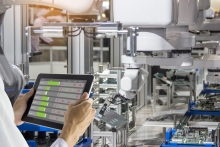 SACA’s Certified Industry 4.0 Professional certification is an engineering certification that focuses on the analysis, design, and optimization of Industry 4.0 systems. It prepares engineers to succeed in positions in modern production environments that use Industry 4.0 technologies.
 -
 SACA’s Specialist certifications certify Industry 4.0 technical skills in operations, troubleshooting, programming, maintenance, and systems integration. Each certification is keyed to a skilled occupation.
 -
 The purpose of the Certified Logistics Technician (CLT) program is to recognize through certification individuals who demonstrate mastery of the core competencies of material handling at the front-line (entry-level through front-line supervisor) through successful completion of the certification assessments.
 -
 Item Number:CPT / CPT+ / CPT 4.0The purpose of the Certified Production Technician (CPT) ® 4.0 certification program is to recognize through certification, individuals who demonstrate mastery of the foundational, core competencies of advanced manufacturing production at the entry-level to front-line supervisor through successful completion of the certification assessments.
 -
 Item Number:CT-SCAMSSC’s Certified Technician in Supply Chain Automation (CT-SCA) logistics certification enables both students and incumbent workers to gain the skills needed to meet the definition of a supply chain automation technician established by the National Science Foundation-funded National Center for Supply Chain Automation: a technician who installs, operates, supports, upgrades or maintains the automated material handling equipment and systems which support the supply chain.