
Explore sustainable building technologies with the Green Energy in Buildings Trainer (122-01). This innovative educational tool offers hands-on learning experiences, real-time energy data monitoring, and practical activities to engage students in STEM education focused on energy efficiency and green technology.
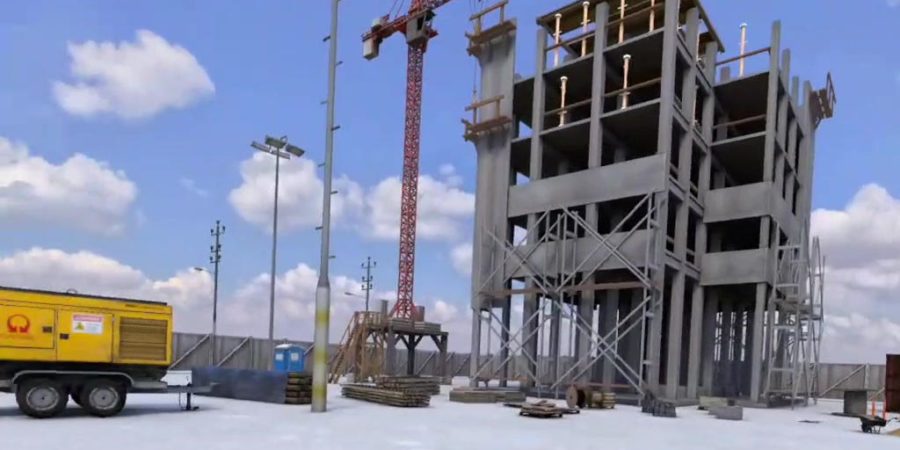
Construction worldwide is growing, and it is not slowing down anytime soon. By 2060, the world is projected to add 230 billion square meters of buildings—equivalent to the current global building stock. With this much-expected growth in the future, construction companies are scrambling to find ways to train their workforce efficiently in this complex and highly varied field.
Upgrade Workforce
Virtual reality can allow trainers to quickly develop modules where learners can be trained on many skills, safety practices, equipment, or hazardous environments before entering the field. This opportunity will save time, money, and energy as they enhance the workforce with these revolutionary solutions.
Closing the Skills Gap
Closing the gap in current training inefficiencies while making the training fun and interactive through virtual training is an opportunity few construction firms want to miss. Develop an innovative training program by investing in your students' success.
Thorough and efficient training should be at the top of all oil and gas industries’ concerns. With such a large, vital workforce, these industries need to prepare their employees to complete their jobs safely and effectively or run the risk of catastrophic—and sometimes fatal—failure.
A standardized, all-encompassing virtual reality training course can help unite and strengthen the training that these employees deserve. This training can allow companies to simulate mock drills, operator qualifications, annual training, and more. Dangerous and life-threatening emergencies such as oil spills, gas leaks, explosions & fires, and chemical exposure can be recreated in virtual environments, guiding trainees in how to properly and quickly respond to these events if they should occur. Hearing, seeing, and controlling the experience from a realistic first-person perspective will make all the difference in how employees will respond on the job.
Within a virtual reality experience, trainees in off-site locations can execute necessary tasks while being evaluated by a senior training manager back at corporate headquarters, saving time, energy, and money for the company. By bringing your company’s safety training to the forefront, your company itself will thrive
American manufacturing is growing faster than in decades, but a shortage of skilled laborers is stunting its full growth. The decline in trade school graduates over the past few decades has left a gaping hole in potential employees. Job openings remain unfulfilled as companies bend over backward to attract new talent to replace the current aging workforce.
These efforts, while noble, can quickly grow costly because of low labor retention and high turnover rates in the manufacturing industry. Adding in the fact that automation and robotics are replacing positions formerly held by humans, it is even more imperative that positions reserved for humans are filled by talented people.
How can manufacturing companies train new hires in cost-effective, engaging, and interesting ways that will encourage them to work longer in the industry? First, integrate VR training with traditional training—which is often conducted in classrooms or on the production line, taking senior employees away from their jobs. Virtual reality training provides manufacturers with the opportunity to simulate a production line environment before new laborers even hit the floor.
Virtual reality can train fresh hires or assess current employees on product assembly, hazard recognition, equipment handling, and more. Whichever way companies choose to utilize this technology, it holds the key to efficiency and future successes for manufacturers.
Every company knows how important it is to be compliant with OSHA protocols. Still, most are not aware of how to efficiently train their employees to follow these guidelines across various disciplines.
Traditional safety training can require costly outside instructors, time off the job, and pricey specialized equipment. Virtual reality, however, can help quickly familiarize novice and seasoned employees with updated safety protocols while saving time, money, and energy for both employer and employee.
Employees trained in these realistic, virtual environments will be familiarized with extreme heights, live wires, complex machinery, and more, helping them build muscle memory and retain pertinent information vital to on-the-job success. Using virtual reality as a training and assessment tool can give management a new perspective on improving their safety training.
ABS-CF10 (acrylonitrile butadiene styrene-carbon fiber) is an ABS thermoplastic with 10% chopped carbon fiber by weight. ABS-CF10 provides a strong, stiff material for the F123™ platform.
System Overview and Compatibility
ABS-CF10 is currently available on the F123™ Series machines with 0.007 inch (0.178 mm), 0.010 inch (0.254 mm), and 0.013 inch (0.33 mm) layer heights. It requires a dedicated ABS-CF10 extrusion head, denoted with a dark green case, for all layer heights for the model material. It is compatible with QSR Support™ as a soluble support system and requires a standard F370™ extrusion head for all layer heights for the support material. This system uses the standard F123 Series build tray. ABS-CF10 and QSR are available in a standard F123 90-cubic-inch spool.
Stratasys ABS-CF10 combines standard ABS (acrylonitrile butadiene styrene) material with 10% chopped carbon fiber by weight.
The result is a low moisture-sensitive FDM® thermoplastic 50% stiffer and 15% stronger than standard ABS 3D printing material.
Typical applications include manufacturing tools, jigs, fixtures and end effectors that benefit from the combination of increased stiffness and reduced weight.
Diran™ 410MF07 is a nylon-based thermoplastic FDM® material, mineral-filled 7% by weight. It demonstrates very good toughness and impact strength combined with resistance to hydrocarbon-based chemicals. Its smooth, lubricious surface quality offers low sliding resistance.
Typical applications include jigs, fixtures and other forms of general manufacturing tooling, and is particularly effective for applications needing a non-marring interface between the tool and the workpiece.
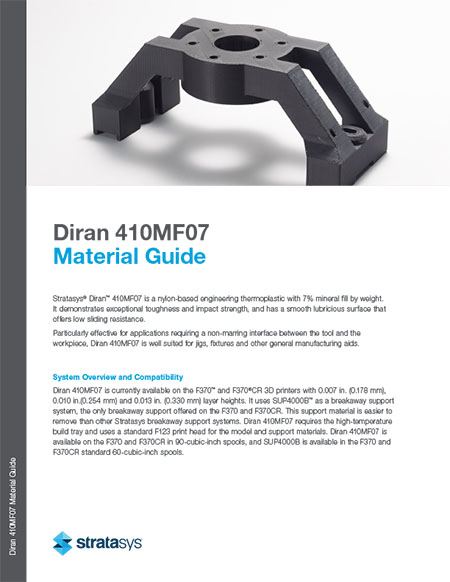
Stratasys® Diran™ 410MF07 is a nylon-based engineering thermoplastic with 7% mineral fill by weight. It demonstrates exceptional toughness and impact strength and has a smooth lubricious surface with low sliding resistance.
Particularly effective for applications requiring a non-marring interface between the tool and the workpiece, Diran 410MF07 is well suited for jigs, fixtures, and other general manufacturing aids.
System Overview and Compatibility
Diran 410MF07 is currently available on the F370™ and F370®CR 3D printers with 0.007 in. (0.178 mm), 0.010 in.(0.254 mm) and 0.013 in. (0.330 mm) layer heights. It uses SUP4000B™ as a breakaway support system, the only breakaway support offered on the F370 and F370CR. This support material is easier to remove than other Stratasys breakaway support systems. Diran 410MF07 requires the high-temperature build tray and uses a standard F123 print head for the model and support materials. Diran 410MF07 is available on the F370 and F370CR in 90-cubic-inch spools, and SUP4000B is available in the F370 and F370CR standard 60-cubic-inch spools.
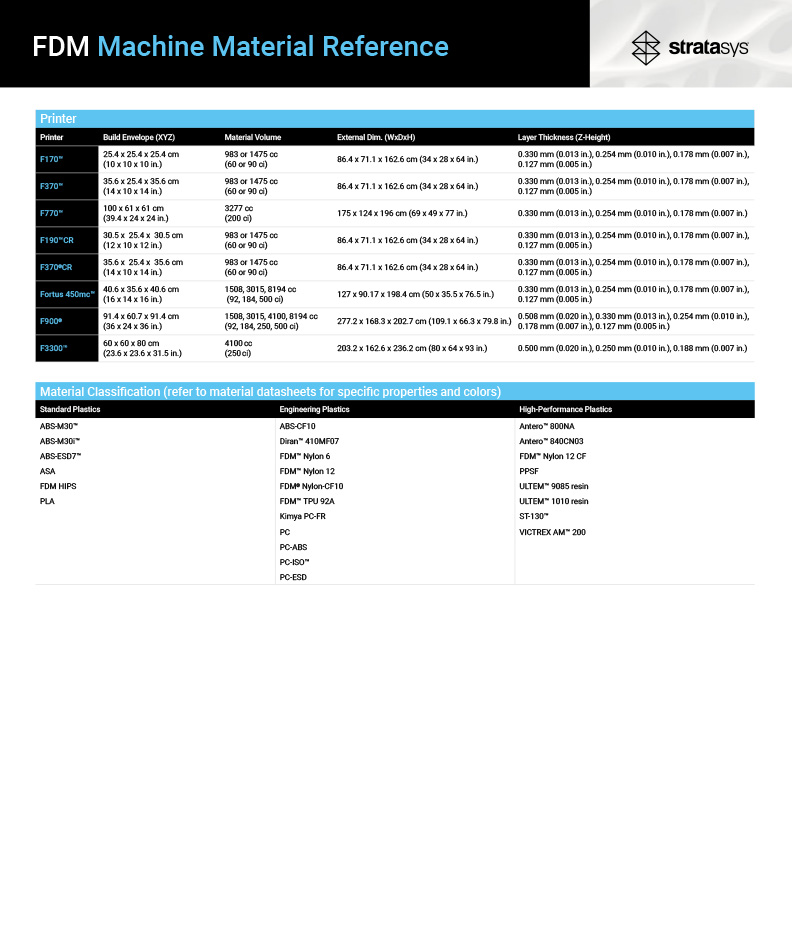
Overview of Stratasys FDM 3D Printers and Materials
FDM® (fused deposition modeling) 3D printers offer unparalleled versatility to turn your CAD files into durable parts. These parts are tough enough to be used as advanced conceptual models, functional prototypes, manufacturing tools, and production parts. Engineers can produce various products just by loading different files and materials. No traditional machining process can do that.
Handling & Finishing ABS-ESD7 Parts
Overview
ABS-ESD7 (static dissipative) material is among the many great materials available for the Fortus systems. This paper will walk you through the handling considerations for ABSESD7, including finishing, safety, and packaging guidelines.
Finishing
This material's most common finishing techniques are bonding and smoothing. For smoothing, sanding is the recommended method. As with all FDM materials, standard sanding processes can be followed. Unlike our standard ABS materials, note that this material cannot be smoothed using the finishing touch station. ABS-ESD7 can easily bond through typical methods, including solvents, epoxies, hot-air welding, ultrasonic welding, and superglue.
Pages
-
 Item Number:122-01
 -
 Item Number:295-708DAC Worldwide's Hammer Union Cutaway (295-708) is a sectioned piping component sample for training in the design, application, use, and safety considerations for hammer unions.
 -
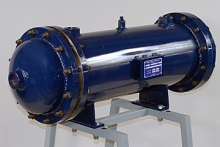 Item Number:238-000DAC Worldwide’s Heat Exchanger Maintenance Training System (238-000) consists of a full-size shell and tube industrial heat exchanger. This flanged, fixed tube, bundle-type heat exchanger represents one of the most common types of heat exchangers learners will encounter on the job.
 -
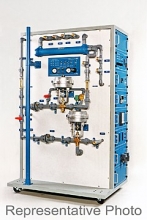 Item Number:607DDAC Worldwide’s Heat Exchanger Process Control Trainer (607D) is a full-sized, working fluid system that allows for hands-on training in measurement and control as it relates to temperature in an industrial fluid process system.
 -
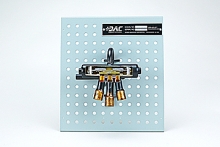 Item Number:373-505This Heat Pump Reversing Valve Cutaway provides a full cutaway view of the reversing valve that exposes the complete internal components and operating principles.
 -
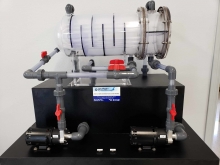 Training aids for heat transfer skills include industrial components like a U-Tube Heat Exchanger, Vertical Thermosyphon Reboiler, Multi-Port Plate Exchanger, Multi-Pass Floating Head, Fixed Tube Sheet Single Pass, and more
 -
 Item Number:TFX-C-HCSTThe TacMed Simulation Hemorrhage Control Skills Trainer - Classroom (HCST-C) is a medical intervention simulator designed to teach fundamental skills for tourniquet application and hemostatic wound packing.
 -
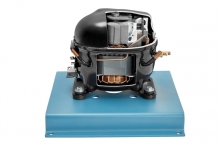 Item Number:373-110DAC Worldwide’s Hermetic Compressor Cutaway (373-110) is an expertly-sectioned example of a common fractional-horsepower refrigeration compressor, which facilitates and supports practical training in compressor design, operating principles, and maintenance.
 -
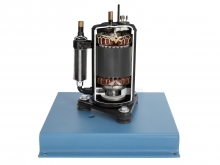 Item Number:373-160DAC Worldwide’s Hermetic Rotary Compressor Cutaway is an expertly-sectioned example of a common fractional horsepower rotary-type refrigeration compressor. The industrial learning device facilitates and supports practical training in AC compressor design, operating principles, and maintenance.
 -
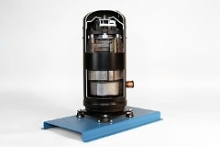 Item Number:373-130This Hermetic Scroll Refrigeration Compressor Cutaway provides a full cutaway view of the compressor body that exposes the complete internal components, and operating principles. Economically mounted on a formed-steel and powder-coated baseplate assembly, the product can be mounted on a variety of related optional display, storage, and workstation products.