

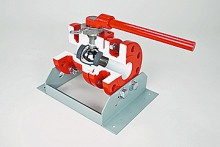
DAC Worldwide's Floating Ball Valve Cutaway (295-753) is a sectioned valve sample for training in the operating characteristics, construction, and maintenance of industrial floating-type ball valves.
Get ready for a new era of 3D printing.
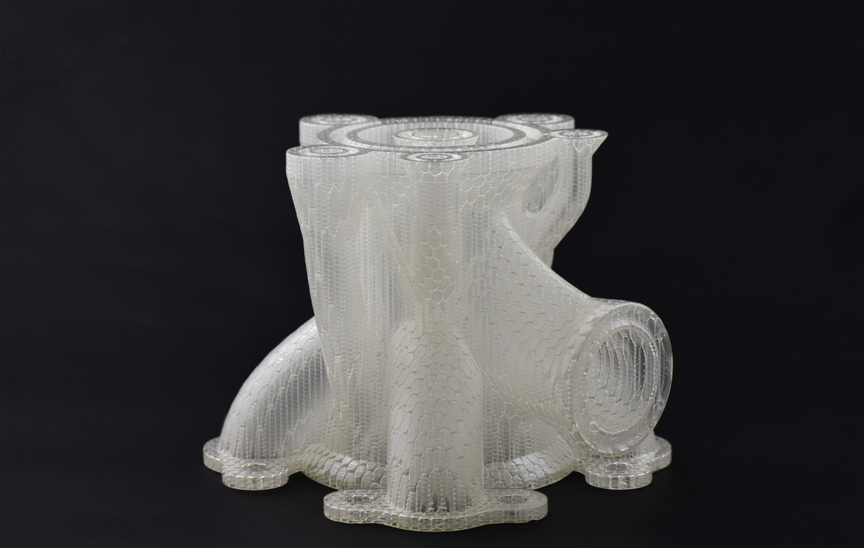
Programmable PhotoPolymerization P3™ technology, an evolution of digital light processing (DLP) is ushering in a new era in 3D printing: the mass production of functional end-use parts.
P3 software precisely orchestrates light, temperature, pull forces and pneumatics to optimize prints for the best possible results. With P3, manufacturers can achieve injection molding part quality and surface finish with incredible accuracy, in a diverse and continuously growing range of high-performance materials.
What makes P3 unique?
P3 is a combination of several tightly controlled, programmable steps in the printing process. P3 extends DLP printing’s capabilities and supports the next generation of production applications made with photopolymers. This powerful combination of production-grade technology and performance materials unlocks functional end-use applications in 3D printing with competitive throughput and part cost.
How it works:
Four critical parts of the P3 process enable the unique combination of high throughput, production-grade part quality and materials.
- Light: Programmable light sets off an exothermic reaction that forms layers with outstanding resolution, accuracy and dosage control.
- Environmental stability: Temperature-controlled printing mitigates warping and shrinkage, while unlocking materials with advanced properties, like flame retardancy.
- Pneumatic separation: A perfectly timed separation procedure reduces pull forces, leading to a molded-like surface finish, high-throughput and ultra-fine features, such as textures or large surface areas like molds.
- Motion: Precise control over printer movements ensures a repeatable, fast and accurate workflow in a wide range of geometries and high-performance materials.
- Green Strength: The P3 process produces a high polymerization conversion, unlocking faster print times, extreme geometries, and build nesting.
Stereolithography is an additive manufacturing process that uses a vat of liquid UV-curable photopolymer resin and a UV laser to build parts one layer at a time.
Benefits of stereolithography include:
- Parts with smooth sidewall quality and detail
- Low-volume part production of complex geometries
- Tight tolerances, layer thickness of between 50 to 200 microns
- Versatile range of materials for specific applications
Stereolithography is commonly used as a prototyping technology within industries that need to print parts or models to validate fit form and function or for concept visualization. Stereolithography is also used in manufacturing applications for short-run part production, such as vacuum castings, injection mold tooling, investment casting master patterns, and functional end-use part production for certain environments.
Due to its competitive build times and the superior quality of the finish straight off the machine, very little post-processing is required, providing cost savings and reduced lead times.
SAF™ Selective Absorption Fusion™
Boost your manufacturing capability with powder bed fusion 3D printing.
SAF technology is the power behind the H Series™ Production Platform, designed for production-level throughput of end-use parts.
The SAF-powered H350™ 3D printer provides you with control over your production and costs. Grow your business through volume production with consistent end-use functional parts.
What is SAF?
SAF is the industrial-grade technology that powers the powder-based additive manufacturing process, leading to higher end-use parts production levels. SAF is the latest 3D printing technology behind the H Series Production Platform that enables control over the printing process to achieve accurate, consistent production at competitive part costs.
How SAF technology works:
SAF is the technology behind the H350’s powder bed fusion 3D printing process. SAF uses HAF™ infrared absorption fluid to fuse polymer powder particles in layers to build parts. It also utilizes Big Wave™ powder management, a proprietary technology that provides reliable powder distribution across the build, where industrial-grade piezo-electric print heads jet the HAF fluid in prescribed areas to create each part cross-section. This is followed by exposure to infrared energy, which causes the areas with HAF to melt and fuse. The sequence is repeated until the parts are completed.
Typical Applications

Industrial-grade technology
Industrial Piezo-electric print heads and innovative powder management designed for durability and high uptime.

Production throughput
One-pass print-and fuse, few consumable replacements for minimal downtime, and high nesting densities to meet production demands.

End-use production parts
Real-time powder heating, unique thermal management, and broad powder range for a wide spectrum of part properties.
Advancing Additive Manufacturing
FDM 3D printed parts are tough enough to be used as advanced conceptual models, functional prototypes, manufacturing tools, and production parts. Using strong, reliable, and durable materials, FDM 3D printers streamline production processes from design through manufacturing, reducing costs and eliminating traditional barriers.
Download our FDM 3D printer systems and materials overview brochure. A much-needed asset for your entry into FDM 3D printing.
Agilus30™ materials have properties that simulate Shore A 30 rubber. With this family of rubber-like materials, you can print flexible full-color 3D prints.
Virtual Reality Training Solutions
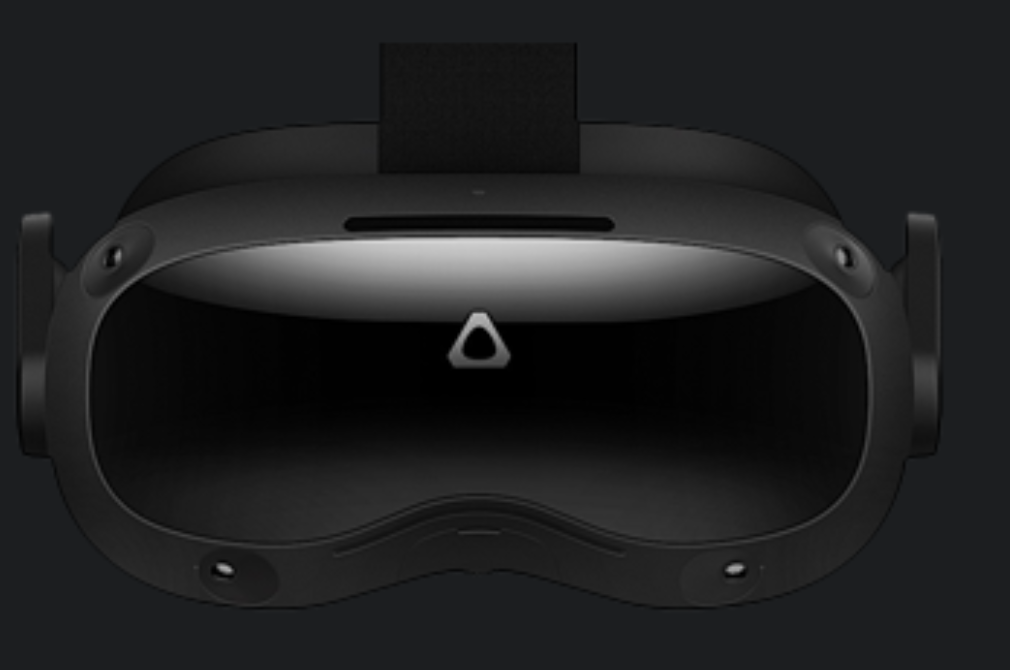
Hard Hat VR's passion is to provide immersive training experiences that save lives, reduce downtime, and increase operational performance. Users can digest and retain complex information much faste using VR. All students learn at different paces and in different ways. Some are visual learners, others work best with hands-on stimulation or verbal commands. VR can facilitate these various learning styles and help students excel and retain vital knowledge.
Visit Hard Hat VR Library Videos
Why VR Training Works
Increases Learning Retention
Reduces Costly Mistakes
Flexible Learning Styles
Increases Engagement
Trackable Results
VR training is proven to help increase employee retention rate to 90.48%. The same study also found that 41.00% fewer errors were made by those trained with VR. This means the gap between the time it takes to implement new employees and procedures effectively closes with VR training.
Products & Services
Off the Shelf VR Training
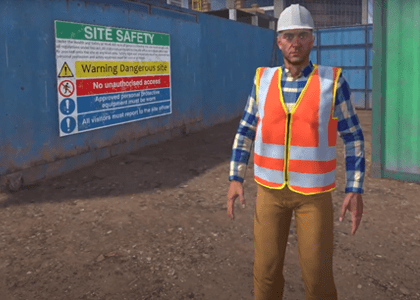
We have ready-to-go VR simulations for the Construction, Logistics, Manufacturing, and Energy Industries. Our off-the-shelf VR content library is Growing with new simulations. Contact us for a demo today.
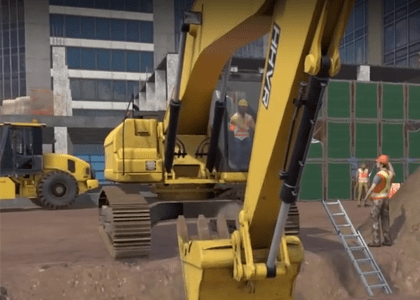
Hard Hat VR Training Platform
This platform combines desktop learning and VR training applications to provide enterprise training solutions for the construction, manufacturing, and energy industries.
Industries Served
Construction
VR training allows users to experience dangerous situations that cannot be done in real life.
Manufacturing
VR training for manufacturing companies help save time, money, and energy for both employer and employee.
Oil & Gas
We provide VR training to the Oil and Gas industry that saves lives and increases productivity.
General Safety
VR safety training is a great tool to guard against workplace injuries that reduce productivity.
VR Content Library
Let us know if you are looking for something that is not in our library.
Our virtual training solutions help build confidence and proficiency in a virtual environment. Virtual reality training is a 3D digital simulation of real-world scenarios for learning. We offer a variety of solutions for construction, oil and gas, manufacturing, and safety.
Pages
-
 Item Number:295-753
 -
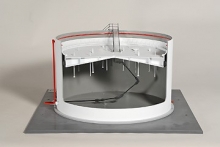 Item Number:295-202DAC Worldwide's Floating Head Bulk Storage Tank Model (295-202) is a highly-detailed scale model of a common floating head storage tank.
 -
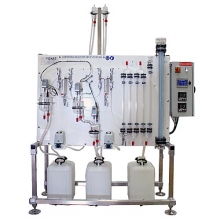 Item Number:RAP/4000This self-contained system facilitates the study of pressure drop due to flow restrictions through valves, strainers, fittings, and pipe of varying diameters, different surface roughnesses, and lengths. The system also facilitates the study of flow rate measurement methods such as orifice assembly, venturi meter, variable-area flow meter, and by calibrated tank vs. time.
 -
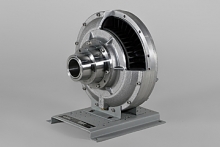 Item Number:200-2082DAC Worldwide’s Fluid Coupling Cutaway (200-2082) is an actual industrial fluid coupling that has been cut away to unveil its primary internal components and to show how it operates.
 -
 Item Number:208-110The replica duplicates all primary structural details on an actual, full-size coupling. Importantly, learners can completely disassemble and reassemble the replica, allowing them to develop skills they will use in the workplace.
 -
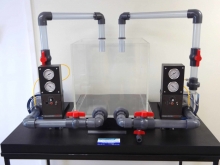 Item Number:102-PDTM2 | 102-PDTM2C | 102-VT | 102-WWTBayport's Fluids Demonstration Models are a very popular tool to teach students the sight and sound concepts of fluid flows which cannot be experienced with drawings or computer simulations.
 -
 Item Number:FLTSimlog's Forklift Personal Simulator puts trainees at the controls of a factory forklift, simulating real-world warehouse and distribution challenges. Train safer, smarter, and at a lower cost with advanced modules that promote safety and productivity.
 -
 This virtual reality course from Hard Hat VR aims to deliver thorough training on the secure and productive operation of forklifts. The primary objective of this course is to educate workers on the best practices and safety procedures associated with forklift operation.
 -
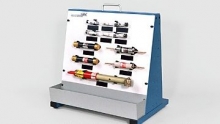 Item Number:816-PACDAC Worldwide’s Fuse Sample Board (816-PAC) is an introductory hands-on teaching aid, designed to supplement courses in fuse selection and maintenance. It includes samples of twelve (12) industrial-quality fuses for users to learn to identify.
 -
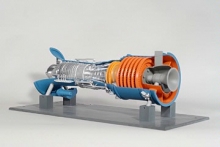 Item Number:295-301DAC Worldwide’s Gas Turbine Model (295-301) depicts a detailed to-scale model of a generic gas turbine.